Designing Concrete Mixtures for Pumpability: The Ultimate Guide !
Introduction: As construction projects become more complex, the use of concrete pumps has become a popular practice. To ensure the success of these projects, it is crucial to design concrete mixture proportions that meet pumpability requirements. However, pumpability is just one of several factors to consider when proportioning a concrete mixture. This blog post will guide you through the process of selecting suitable proportions for pumpable concrete, taking into account various considerations and factors outlined in the ACI 211.9R-18 guide. Considerations for Proportioning Pumpable Concrete:
1. Aggregate Grading: The first step in quality concrete proportioning is to ensure appropriate combined aggregate grading. This is equally important for pumpable concrete. Consistency in grading promotes consistent pumpability. Therefore, regular monitoring of aggregate grading and necessary adjustments should be made to maintain consistency.
2. Fine Aggregates: When selecting suitable fine aggregates, it is recommended to refer to the solid line curves in Figure 3.2.2a and 3.2.2b of the ACI 211.9R-18 guide. These curves provide guidance on the percentage passing each screen size and the individual percent retained on each screen. Adhering to the suggested limits and curves ensures the pumpable concrete meets the required standards.
3. Combined normal weight aggregates : The combined percent of the mixture volume should be evaluated for combined grading purposes. Figure 3.2.3a is a recommended combined grading for evaluating the pumpability of a concrete mixture proportioned by combining the fine and coarse aggregate with NMS from 3/4 in. to 1-1/2 in. (19.5 to 37.5 mm).
Tables 3.2.3a and 3.2.3b suggest volume ranges for determining the weights of coarse aggregate for pumpable mixtures depending on the FM of the fine aggregate. This information is based on the values shown in Table 3.2.2 and reflects differences in characteristics of rounded river gravel (Table 3.2.3a) and crushed stone (Table 3.2.3b).
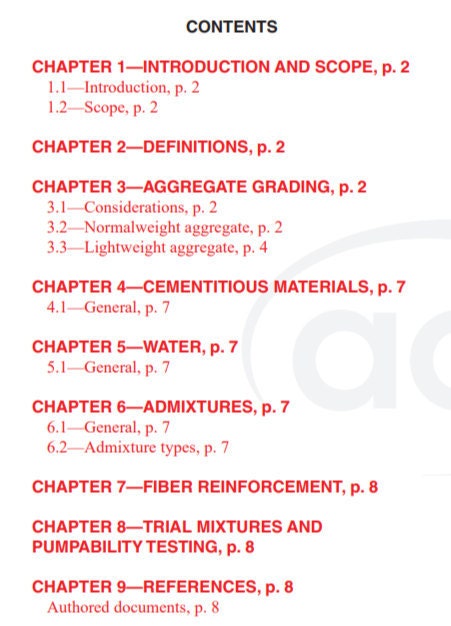
4. Cementitious Materials: Chapter 4 of the ACI 211.9R-18 guide provides general information about cementitious materials used in concrete mixtures. It is essential to consider the type and properties of cementitious materials while proportioning pumpable concrete.
5. Water: Chapter 5 emphasizes the importance of water in concrete mixtures. The quality and quantity of water can significantly impact the pumpability of concrete. Careful consideration of the water content and its effects on the mixture's consistency is crucial.
6. Admixtures: Chapter 6 of the guide discusses the role of admixtures in concrete mixtures. Admixtures can improve or modify the properties of concrete, including its pumpability. Understanding the different types of admixtures and their effects can help in proportioning pumpable concrete.
7. Fiber Reinforcement: Chapter 7 explores the use of fiber reinforcement in concrete mixtures. While not directly related to pumpability, fiber reinforcement can enhance the overall performance and durability of the concrete.
8. Trial Mixtures and Pumpability Testing: Chapter 8 highlights the importance of conducting trial mixtures and pumpability testing. These tests help evaluate the pumpability characteristics of different concrete mixtures and allow for adjustments and improvements before the actual construction.
Conclusion: Proportioning pumpable concrete requires careful consideration of various factors outlined in the ACI 211.9R-18 guide. By paying attention to aggregate grading, fine and coarse aggregates, cementitious materials, water, admixtures, fiber reinforcement, and conducting trial mixtures and pumpability testing, the desired pumpability and performance of the concrete can be achieved. Consulting the guide and collaborating with experienced professionals will ensure the successful execution of construction projects involving pumpable concrete.
https://concretebycesar.etsy.com/listing/1603058123